Best Buys
Blog / Fun Facts

5 Reasons Why You Should Never Skip an Oil Change

tools hanging in a shop
Have you had a look at your car's dipstick lately? Most drivers know how important oil is to a well-running engine. If you're not sure, here are five reasons why you should never skip an oil change.

It Lubricates Your Engine

Many of your engine's components, like pistons and valves, are continually moving as you cruise down the road. To avoid being damaged, they need to be adequately lubricated. Oil provides this vital role. Over time, the heat from the engine breaks the oil down, and it becomes contaminated with dirt and debris, making it impossible to do its job.

Keep Your Cool

Oil helps keep engine components cool. Moving parts create friction, which in turn generates heat. Engine oil is the perfect solution to reduce friction and prevent your engine from overheating.

Oil Changes Removes Sludge

Every time you change your oil, your technician replaces the oil filter as well, removing particles and sludge from your engine's systems. Dirt and dust are deadly to your vehicle, causing corrosion over time, decreasing the life of your car's motor. If you don't change the oil regularly, it breaks down and turns to sludge. Keep your engine running at peak condition with clean oil.

You'll See Better Gas Mileage

Your vehicle's overall fuel efficiency is affected by several factors from where you live to your driving habits and how well you maintain it. A poorly lubricated engine won't perform at its best, leading to increased fuel consumption. According to one study by the U.S. Department of Energy, routine changes with the right kind of oil can improve your gas mileage by as much as 2%. While that figure may seem low, for the average commuter, that could equate to a free tank of gas each year. The agency recommends oil that's labeled "Energy Conserving" to ensure it offers friction-reducing additives.

Your Car Will Last Longer

It's a simple fact that owners who routinely change their oil can expect their vehicle to last longer than those who skip this critical maintenance. Buildup from dirty oil makes your engine work harder, wearing out internal components faster. An engine that works too hard will end up with a shorter life span, and a lower value if you plan to sell it or trade it in on something new. Having copies of these regular maintenance records increases its resale value, according to the experts at Kelley Blue Book. Dan Ingle, Vice President of KBB's valuations, reports that regular oil changes are a better indication of proper upkeep than tune-ups and further states that this habit is a good sign that your car has been cared for. Getting your oil changed regularly may seem like a hassle. However, it's a vital task if you want to hop in your car and go. Look for online coupons to save a few bucks. If you're not comfortable changing the oil yourself, hire an experienced professional mechanic to do it for you, like those you'll find at your local dealership.  
Posted in:

Related Posts

10 Tips for Improving your Gas Mileage

Image Source: https://www.istockphoto.com more 1. Give your Tires the Attention they Need Saves up to 8 cents per gallon. One of the easiest ways to improve fuel economy is make sure your vehicle’s tires are properly inflated. A recent report from the Rubber Manufactures Association, the national trade association for tire manufacturers, revealed that only one of every six vehicles on the road today have their tires inflated correctly. This error can not only negatively impact your fuel economy, but it can also cause improper tire wear and vehicle handling. According to the National Highway Traffic Safety Administration, improperly inflated tires contribute to more than 600 fatalities and 33,000 injuries annually in the United States. In addition to inflating your tires correctly, getting your tires rotated and balanced will also help to improve gas mileage. Always check your tire pressure in cool conditions, ideally when the vehicle has been sitting in shaded conditions for at least 8 hours. Image Source: https://www.istockphoto.com 2. Get the Junk out of the Trunk Saves up to 6 cents per gallon. Cleaning your vehicle of any extra, unneeded items can also be an easy way to improve your vehicle’s gas milage. By reducing the weight in your vehicle, you can instantly increase your fuel economy. There are some items you should always keep in your car, like an emergency kit, jumper cables, and a spare tire. However, as little as 100 pounds can reduce your fuel economy. Clearing out unnecessary and unused items like forgotten backpacks, books, and work out equipment can help lighten the weight. The lightened load will also put less stress and strain on your vehicle’s components and systems, such as the engine and the brakes.  Add-ons like bike racks, cargo racks, and roof racks can also be removed, and rear-mounted cargo racks are a better option if you need to haul additional items. At highway speeds, roof-mounted cargo boxes can reduce fuel economy by 6-17%, while their rear-mounted counterparts typically have a 1-5% impact. Image Source: https://www.istockphoto.com 3. Turn Off your Engine Saves up to 2 cents per gallon for every 2 minutes. Another easy way to save money on fuel economy is to simply turn off your car’s engine when idling. Idling refers to a running vehicle that’s not in motion, including stopping for a traffic light for over 30 seconds. You may have noticed that some newer vehicle models already feature a stop-start system. This allows cars to conserve fuel by automatically shutting down the engine when the car comes to a stop, and the engine will automatically restart when the brake is released. Idling uses more fuel than restarting your vehicle, and gives off 80% more pollution than when your car is in motion. Another fun fact – you don’t need to “warm up” your engine before you hit the road, it’s just a myth that costs you money! Auto experts say that you shouldn’t take more than 30 seconds to warm up your car in the winter months. The engine will warm up faster as it’s being driven, and it’s better to turn your engine off and start it again than to leave it idling. Image Source: https://www.istockphoto.com 4. Use the Ideal Motor Oil for your Vehicle Saves up to 5 cents per gallon. Whether you decide to have a professional handle your oil changes or you prefer to do it yourself, be sure that you are using the best motor oil for your specific vehicle. There are a few primary engine oil types to choose from, including Conventional Oil, Synthetic Oil, Synthetic Blend Oil, and High Mileage Oil. There are also many factors you should consider for your vehicle’s oil, like the age of your vehicle, your own driving style, and the climate where you drive. Always follow the vehicles owner’s manual to determine the proper viscosity grade, engine oil specification, and oil drain interval. If you’re still not sure what oil to choose for your vehicle, and specifically which option is best for your fuel economy, you can book an appointment with one of our highly knowledgeable and friendly Service team members. Image Source: https://www.istockphoto.com 5. Replace your Dirty Air Filters Saves up to 15% of fuel consumption. Your vehicle’s system traps contaminants in an air filter made up of paper and synthetic fibers. Over time, the filter becomes filled with dirt and debris, preventing the engine from breathing properly. As a result, the engine will have to work harder and use more fuel. Replacing your engine’s air filter will restore the vehicle’s performance and efficiency, while improving the driving ability of the car and its gas milage. Not only does a dirty air filter cost you more money at the pump, it also jeopardizes the vehicle’s engine. The best rule of thumb is to check your air filter once a year, and exchange your air filter according to the manufacturer’s specifications in the vehicle’s owner’s manual. Image Source: https://www.istockphoto.com 6. Give your Breaks a Break Saves up to 99 cents per gallon. If you find your left foot constantly pressing on the breaks while you’re driving, you’re causing a lot more damage than you think. Firstly, doing this will wear down the pads and rotors prematurely. Secondly, forcing your car to take sudden stops and quick accelerations can stress your vehicle’s system, causing it to use more energy and fuel to drive and to stop. Of course, sudden braking can’t always be avoided, but it should only be used when necessary. Instead, when approaching a traffic light or stop sign, take your foot off the accelerator and wait before applying the breaks by allowing your vehicle to slow down on its own. Not only will your car appreciate the stress taken off the breaks, but your passengers will enjoy a smoother ride as well! If you’re unsure about the performance of your breaks, you can schedule an appointment with our talented Service Team here to make sure you’re driving safely and efficiently. Image Source: https://www.istockphoto.com 7. Consider a Front-End Alignment Saves up to 28 cents per gallon. We’ve all braced ourselves from the impact of hitting a pothole while driving in our vehicle. Over time, these impacts to our cars lead to a misalignment in the wheel system. Instead of rolling freely, misaligned tires drag along the road. A misaligned vehicle reduces mileage, causes premature tire wear, and forces your engine to work harder than usual. Fixing the issue will help improve steering, give you and your passengers a smoother ride, allow your tires to have a longer life-span, and can help keep your car out of the shop with fewer auto repairs.  If you notice your car pulling to one side of the road while driving, or you can feel vibrations while driving, it may be time for a wheel alignment. Image Source: https://www.istockphoto.com 8. Fill your Tank Early or Late Saves up to 8 cents per gallon. Car fuel is dispensed by volume and gasoline, like all liquids, expands when heated. Because of this, gasoline will be denser in the cool temperatures of the early morning or late evening. The dense fuel will allow your vehicle to run longer on the same amount of fuel pumped into the car. Image Source: https://www.istockphoto.com 9. Keep Up with Maintenance Saves up to 4% on fuel economy. One of the best ways to improve your gas mileage is to keep your car in great shape. A faulty engine or failed emissions test can drain your fuel tank.  ExxonMobil claims that regular tune-ups can increase efficiency by 4%. AAA puts this percentage much higher, saying that significant engine problems can cause you to use up to 50% more fuel. Ensuring your vehicle is running at its best performance level will not only help your fuel economy, but will also improve the driving ability and the car’s financial value. Our Service Team at Taylor’s Auto Max can diagnose any auto repairs needed and make sure that your car is operating at it’s very best. Click here to schedule an appointment. Image Source: https://www.istockphoto.com 10. Take it Slow and Enjoy the Ride Saves up to 20 cents per gallon. When driving somewhere, most of us have a destination to get to or people to see. Usually, we want to get to our stop as quickly as possible, but constantly leading the pack on the road can cause your fuel economy to decrease. When you regularly demand your vehicle to accelerate quickly, you force your engine to work harder than it needs to. Aside from quick accelerations, if you simply lower your overall speed, you will notice your fuel can be stretched further. According to Integrity First Car Pros, you can save around 7% on fuel consumption for every 5-mph reduced. Driving along an open road in the beautiful state of Montana is an experience you shouldn’t rush. Image Source: https://www.istockphoto.com Sources: https://www.ncconsumer.org/news-articles-eg/properly-inflated-tires-save-money-and-lives.html https://www.gmfinancial.com/en-us/financial-resources/articles/improve-fuel-efficiency.html https://www.washingtonpost.com/news/wonk/wp/2014/12/29/the-biggest-winter-energy-myth-that-you-need-to-idle-your-car-before-driving/ https://www.firestonecompleteautocare.com/blog/oil-change/how-to-pick-the-best-motor-oil/# https://brakeexperts.com/why-does-braking-use-fuel/ https://www.pgfilters.com/blog/can-replacing-air-filter-improve-gas-mileage/ https://www.firestonecompleteautocare.com/blog/alignment/benefits-of-wheel-alignment/ https://www.ndtv.com/business/petrol-diesel-why-you-should-refuel-in-the-morning-387240 https://www.integrity1auto.com/9-tips-to-increase-gas-mileage-up-to-45-percent/


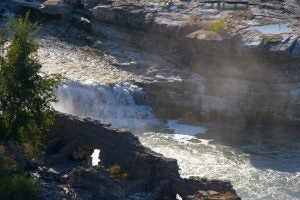
the great falls waterfall wide view with rocks and trees

Check Out the Five Falls near Great Falls, Montana

If you've ever seen a waterfall in person, you know how great of a sight it can be. Every year, many people go on trips to find waterfalls. Fortunately, the Missouri River makes it easy. Within a 10 mile stretch of the river near Great Falls, Montana, there are five waterfalls that you can visit near our Buick, GMC & Nissan dealership. If you like to look at natural wonders, then check out the five falls near Great Falls, Montana. Shop Vehicles For Sale in Great Falls, MT at Taylor's Auto Max Explore the surrounding waterfalls with a brand new vehicle! Our new and used car dealership in Great Falls, MT offers a wide selection to choose from. Get started by checking out available vehicle inventory for sale below: Used cars for sale Buicks for sale GMCs for sale Nissans for sale 1. The Great Falls The Great Falls is the largest of the five falls. It towers over the others at 87 feet and is the furthest south in the chain. It is a great way to start or end your trip to get the full grandeur of the experience. If you want to visit the Great Falls, it is best to do so in early spring or in the fall. At its full flow, the falls are more than 900 feet wide. However, it runs almost completely dry in the summer since the water has to be diverted to a nearby dam due to increased power consumption in the summer. Still, it is an interesting place to visit any time of year, especially since you get to see the back of the falls without getting wet. more 2. Rainbow Falls The Rainbow Falls gives you a more interesting view as it has been modified by the Rainbow Dam just upstream. Rainbow Falls is more than 1,600 feet wide when it is at peak capacity. However, the dam restricts the flow in the center much of the time, so the falls split in half and run down the sides of the river. 3. Crooked Falls Crooked Falls is further upstream and gives you another display of a natural shaping to the falls. It follows a wide horseshoe shape and has a 19-foot drop. You can see the falls easily and it is not far from Black Eagle and Colter Falls. 4. Black Eagle Falls Black Eagle Falls is another option for your trip. It is an impressive 26-foot drop. It was the first of the Five Falls to have a dam built to power nearby cities. At full capacity, the falls return to its full 26-foot overflow. However, you can see it in various states based on the power needs of nearby Great Falls Montana. It gives you an easy way to see both an uncovered dam and a waterfall. 5. Colter Falls Although still included in the Five Falls, Colter Falls is the hardest to see. That is because it was modified by the dam so much that the area around it became a reservoir. So, the falls are underwater most of the time. The only time that you can see the falls is if there is extreme drought and the dam is forced to dump most of its water. If you can find it, it is a rare treat. Visiting the Five Falls can be a lot of fun when you go at the right time of year. If you are lucky and well prepared, you'll get to see all of them. View Vehicle Lease Deals & Specials at Taylor's Auto Max Are you in the market for a new or used car, but want a price that won't break your budget? Then check out our current lease specials and used car offers. We have competitive pricing on new and used Buicks, GMCs, Nissans and more! Used car offers Buick lease specials GMC lease deals Nissan lease & finance offers Image by ahisgett cc by 2.0

A film reel from Forrest Gump | Taylor's Auto Max

4 Movies and TV Shows Filmed in Montana

Montana's natural beauty appeals not only to nature enthusiasts and the outdoorsy population, but also to large film production companies. Every year, producers and their casts travel to Montana to film full movies or television shows or to shoot individual scenes. You might be surprised to learn that many famous movies and TV series were produced in Montana. Here is a little sneak peek at some of them. more Forrest Gump This well-known 1994 romantic drama portrays the life story of Forrest Gump, a kind but slow-witted man from Alabama. Based on the 1986 novel by Winston Groom and directed by Robert Zemeckis, the movie stars Tom Hanks, Gary Sinise, Robin Wright, Sally Field, and Mykelti Williamson. The movie's two famous scenes in which Forrest Gump is running through Montana were filmed in or around Glacier National Park in Northwestern Montana. The first scene, where you can see golden wheat fields for a brief moment, was shot near Cut Bank, Montana. The other scene, picturing snowy mountain peaks in the background as Forrest jogs across a stone bridge, was filmed at the St. Mary Entrance to Glacier National Park. Beethoven 2 "Beethoven 2" is the first sequel of the famous 1992 family film "Beethoven." "Beethoven 2" was produced the following year due to the unexpected popularity and financial success of the original "Beethoven." The movie was directed by Rod Daniel, and it stared Charles Grodin, Debi Mazar, and Bonnie Hunt. Though the Newton family's home was in Pasadena, the scenes in the park were shot at Montana's Glacier National Park. Always A remake of the 1943 romantic drama, "A Guy Named Joe," "Always" is a 1989 romantic comedy-drama directed by Steven Spielberg. It stars Richard Dreyfuss, Holly Hunter, John Goodman, Brad Johnson, and Audrey Hepburn. "Always" is a true Montana film ― not only was it produced in Montana, but also features Montana residents. Its production took place at Kootenai National Forest, Montana. Several scenes were shot in and near Libby, Montana. "Always" recruited about 500 Libby's locals for wild-land firefighter roles. The opening scenes with the plane hovering over the lake were filmed at Bull Lake, Montana. Yellowstone This 10-episode cowboy drama from Paramount Network just aired in June of 2018. It stars Kevin Costner, Wes Bentley, Kelly Reilly, and Lude Grimes. In its production, "Yellowstone" took advantage of everything Montana has to offer ― its natural splendor, impressive estates, and historic sights. The family's ranch pictured in the series is the Chief Joseph Ranch in Darby, Montana, the state's historic landmark. The production of court scenes took place in the Old Supreme Court chamber in Montana State Capitol in Helena. Some scenes were shot at the Crow Indian Reservation in Southern Montana, by the Big Hole River between Butte and Melrose, in a small town of Darby, and in the Bitterroot Valley. These movies and TV series are just a few highlights of the numerous productions taking place in the state of Montana year after year. Next time you watch these movies, think about Montana. Image by DRs Kulturarvsprojekt, Licensed via CC BY-SA 2.0